Kartavya
Gallery | Links:
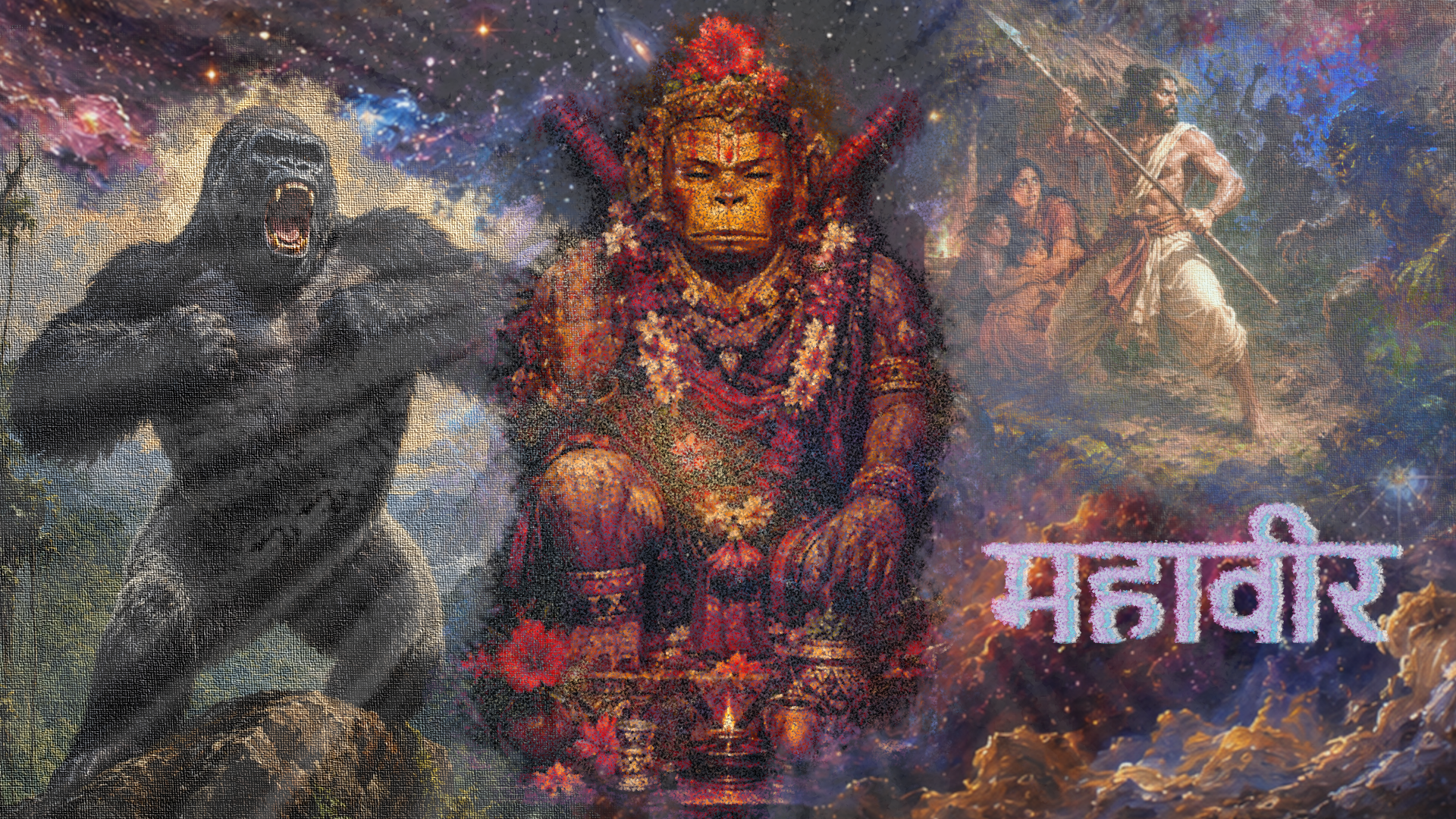
I’ve always been deeply interested in pagan customs and cultures. They reveal how our ancestors understood their relationship with the natural world—the same world that sustained them, threatened them, and shaped the rhythms of their lives. What fascinates me most is how often different cultures gave sacred form to strength. The Norse looked to Thor, the Japanese to Hachiman, and the Greeks revered Heracles—the same hero the Romans would later know as Hercules. In ancient India the Hindu tradition invoked Hanuman. Across these traditions, strength was rarely understood as brute force alone; it carried purpose, responsibility, and the obligation to act when the moment demanded it.
Kartavya in sanskrit means “that which must be done” —one’s duty, obligation, or necessary action. It’s the moment when responsibility becomes unavoidable. Once dharma makes the right course of action clear, inaction is no longer neutral; it becomes a failure to answer what the moment calls for. Hanuman, or Mahavira embodies this principle through strength placed in service of duty.
Mahāvīra serves as inspiration for how we might confront moments that demand action. When we find ourselves in a situation where we are uniquely capable of protecting someone, correcting a wrong, or delivering justice, we can discover a strength within ourselves that is far greater than we imagined. We see it in mothers lifting cars from their children, siblings assuming responsibility for one another, and pacifists throwing the first punch to defend someone they love. In such moments, action is immediate, deliberate, and absolute. The certainty comes from recognizing, without hesitation, that this is your place to intervene. It is your dharma. The response does not feel calculated so much as awakened—erupting from within like a lightning strike or a thunderous roar.
The point of Kartavya is not that we should seek conflict, glorify violence, or imagine ourselves as heroes. It is that there are moments when hesitation becomes its own moral choice. Strength matters most when it is placed in the service of something beyond the self—when fear, comfort, and self-preservation give way to responsibility. Hanuman represents the refusal to remain passive when duty has made itself known. In that instant, action is no longer optional. It is simply what must be done.
